
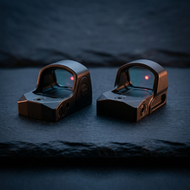
Enclosed vs Open Emitter Red Dots: Which Is Better?
Posted by D&R Sports Center on Mar 18th 2026
Reflex red dots come in two structural types, and the difference matters most when conditions get ugly. Compare both across red dot sights.
Open emitter
An open-emitter optic has an exposed LED that projects up onto a single lens. It is lighter, smaller and typically less expensive, and it dominates the pistol optics market. The vulnerability is that the emitter is open to the elements — mud, snow, rain or pocket lint on the emitter or lens can dim or block the dot until you wipe it clear.
It is worth being precise about how the failure happens, because it is not what people picture. The emitter fires forward and up at the underside of the lens. Anything that settles on the emitter itself — a drop of rain, a smear of mud, a plug of lint — is directly in the light path at its narrowest point. A tiny amount of debris in exactly that spot does far more damage than the same amount anywhere else on the optic.
The practical symptom is a dot that dims, smears or vanishes while the window still looks perfectly clear. You usually discover it at presentation, which is the worst possible moment.
Enclosed emitter
An enclosed-emitter optic seals the LED inside a tube between two lenses, like a miniature tube sight. Nothing can settle on the emitter, so the dot keeps working in rain, snow and debris — a real advantage for duty use and deep concealment carry, where lint is the enemy. The trade-offs are slightly more size, weight and cost. Holosun offers both types, including the enclosed EPS family.
The design also means that if the front window gets obscured, you lose the view but the dot itself is unaffected — whereas on an open emitter a blocked emitter removes the dot while you can still see through the glass perfectly well. Losing the picture is obvious and you react to it. Losing the dot while the picture looks fine is the dangerous failure.
Where this actually bites: appendix carry
The scenario that converted most of the carry market is specific. An optic carried inside the waistband sits against clothing, pressed into the body, for hours. Lint from a shirt collects in the emitter recess. Sweat carries it in and dries it there.
Shooters who carry appendix with an open emitter learn to check and clear the emitter as part of holstering. That works, and plenty of people do it for years without incident. But it is a maintenance task that an enclosed optic simply does not have, and that is the whole argument.
Rifle optics are less affected because they are not pressed against a body, but they are exposed to weather for longer. A carbine left muzzle-up in rain will collect water in an open emitter recess.
What enclosed costs you
Be realistic about the trade rather than treating enclosed as strictly better.
Size and weight. A second lens and the housing to hold it add bulk, and on a slim carry pistol that can be the difference between an optic that disappears under a shirt and one that prints.
Cost. Enclosed optics generally cost more for comparable features.
Two surfaces to keep clean. You now have a front and rear lens, both of which fog, smear and collect rain. Enclosed does not mean maintenance-free; it means the emitter is protected.
Footprint. Enclosed carry optics often use their own smaller footprints rather than the RMR pattern, so they are not always a drop-in replacement. Check before ordering.
Which should you choose?
- Open emitter for the lightest, most affordable setup and typical range and carry use.
- Enclosed emitter for duty, all-weather reliability, or lint-prone concealed carry.
A simple way to decide: does this optic spend its life pressed against your body or exposed to weather? If yes, pay for enclosed. If it lives on a range gun in a case, an open emitter is lighter, cheaper and gives up nothing you will notice.
Footprint still governs what fits your slide — read pistol red dots and footprints — and if you are weighing specific models, see Holosun 507C vs 508T vs EPS Carry and green dot vs red dot.