
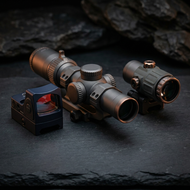
The Best Optic for an AR-15: Dot, LPVO or Magnifier?
Posted by D&R Sports Center on Apr 2nd 2026
The AR-15 is the most-optic'd rifle in America, and the "best" setup depends entirely on your distances and role. Three approaches cover almost everyone — and the right one is decided by a single honest question, which we will get to at the end.
Red dot: speed and simplicity
A red dot is the fastest, lightest, most reliable and most affordable option, with battery life measured in years. It excels from arm's length to a few hundred yards and is the default for a home-defense or general-purpose carbine. The limit is target ID and precision at distance.
The reason a dot is fast is that it is parallax-free at any head position for practical purposes — if you can see the dot, the rifle is pointed where the dot is. You do not need a perfect cheek weld, which means you can shoot from awkward positions and while moving without hunting for a sight picture.
Within the category, the main choices are tube versus open frame, and reticle size. A 2 MOA dot is more precise at distance; a 65 MOA circle with a 2 MOA dot inside it is faster up close and still precise when you need it. Our comparison of the Trijicon MRO and Holosun AEMS covers the tube-versus-open-frame decision in detail.
LPVO: one optic, whole envelope
An LPVO gives you true 1x speed and dials up to 6x-10x for reach and target ID — the most versatile single optic. It weighs and costs more than a dot. See the LPVO buying guide to choose magnification, and ACOG vs LPVO for the fixed-power alternative.
The thing to understand about LPVOs is that the quality of the 1x is everything. A good one at 1x is close enough to a red dot that you can shoot it both-eyes-open at speed. A poor one is slightly magnified, your eyes refuse to merge the images, and you have bought a scope that is slow up close and mediocre far away. If the budget will not reach a genuinely good 1x, buy a dot instead and spend the difference on ammunition.
Budget for the mount too. An LPVO needs a one-piece cantilever mount at the right height, and that is a real line item rather than an afterthought.
Red dot plus magnifier: flexible middle ground
Keep your fast dot and add a flip-to-side magnifier to reach mid-range on demand — covered in do you need a magnifier. It is heavier than a bare dot but keeps 1x speed as the default.
This is the setup that looks best on paper and divides people most in practice. The honest assessment: it works well if you spend most of your time at 1x and occasionally need to identify something further out. It works badly if you end up magnified most of the time, because then you are carrying a dot, a magnifier and two mounts to do a job one LPVO would do better.
A total cost check is worth doing. A quality dot plus a quality magnifier plus mounts often lands close to a decent LPVO.
The prism option, especially for astigmatism
There is a fourth path that gets overlooked. A prism scope has an etched reticle rather than a projected dot, so it works with the illumination off and — crucially — it looks sharp to shooters with astigmatism, for whom red dots often smear into a comma or starburst.
If you have ever looked through a red dot and thought the dot was defective, it probably was not. See prism scope vs red dot vs LPVO before you spend money on a third dot hoping for a different result.
Mount height matters more on an AR than anything else
The AR's stock comb sits low relative to the bore, so optic height changes your head position significantly. Too low and you are craning down; too high and your cheek leaves the stock.
For a red dot, the common choices are absolute co-witness (irons centred in the window) and lower 1/3 co-witness (irons in the bottom third, giving a cleaner primary view). Lower 1/3 is the more popular modern default because it keeps the backup irons available without cluttering the sight picture. Our guide to co-witnessing iron sights with a red dot explains the difference.
For an LPVO, 1.5 inch and 1.93 inch mount heights are both common, with the taller option giving a more upright head position that many shooters find faster and more comfortable in body armour or a plate carrier.
Don't forget the light
Any defensive carbine needs a weapon light to identify targets in low light. You cannot shoot at what you cannot identify, and an optic does nothing for you in the dark. This is not an accessory; on a defensive rifle it is as fundamental as the sight.
See how to choose a weapon light for lumens, candela and mounting, and the best home-defense optic setup for how the two work together.
So which should you buy?
Answer this honestly: what is the furthest distance at which you will realistically need to identify and hit something?
- Inside 100 yards, mostly close: a red dot. Nothing else is faster, lighter or more reliable, and you will not miss the magnification.
- Out to 300 yards, occasionally needing to identify: a red dot plus magnifier, or a prism if astigmatism is in play.
- Genuinely variable, from across a room to several hundred yards: an LPVO, and buy a good one.
Most people overestimate their realistic distance and buy more optic than the rifle will ever use. There is no shame in a red dot on a carbine — it is the right answer far more often than the internet suggests.
Whichever optic you choose, mount it at the right height — see the mounting guide — and prefer a red dot or holographic if you want the simplest, most robust setup. Compare red dot vs holographic to finish.