
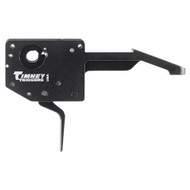
Bolt-Action and Rimfire Trigger Upgrades: Remington 700, Tikka, Savage, Ruger
Posted by D&R Sports Center on Nov 13th 2026
A factory bolt-action trigger is built to pass a lawyer's review, not to help you shoot small groups. Heavy, gritty or creepy pulls are the norm, and a replacement trigger is one of the few upgrades that makes almost every shooter better the same afternoon. But "a trigger for my rifle" hides a string of decisions: which exact action you have, whether the new unit carries its own safety and bolt release, single-stage or two-stage, how light is sensible, and whether you should be the one installing it. Work through them in this order and you will order the right part the first time.
1. Identify your action exactly — model, generation and hand
Bolt-action triggers are not universal. Each one is machined to the pin locations, sear geometry and housing shape of one action family, and close is not good enough. Before you browse our trigger range, write down the rifle's make, model, generation and whether the action is right- or left-handed. The traps we see most often at the counter:
- Remington 700 and its clones. The 700 footprint is the most widely copied in the industry, so a "Remington 700" trigger also serves many custom 700-pattern actions and the 40X. The catch is the bolt release, covered in step 2.
- Ruger American Gen I vs Gen II. Timney builds separate triggers for each generation — for example the Gen I straight single-stage and the Gen II straight single-stage. Check which generation you own before ordering.
- Savage: AccuTrigger or not. Savage centerfires split into rifles with the AccuTrigger (the small blade in the middle of the trigger) and older rifles without it. The Timney trigger for Savage Accutrigger rifles is listed for AccuTrigger guns and specifically does not fit the A17, A22, Impulse or rimfire models, while the Timney Savage 110/Stevens 200 trigger covers the Savage 110 and Stevens 200.
- Browning X-Bolt vs X-Bolt 2. Two different rifles, two different Timney units: the X-Bolt trigger and the X-Bolt 2 trigger.
- Winchester Model 70. Model 70s built with the MOA trigger take a specific unit — the Timney trigger for Model 70 rifles with the MOA trigger — so confirm which trigger your 70 left the factory with before you buy.
- Howa 1500 mini actions. The Timney Howa 1500/Weatherby Vanguard trigger is listed as not compatible with Howa mini actions.
- Left-handed rifles. A left-hand action needs a left-hand trigger. TriggerTech builds true left-hand units for the 700 and for the Tikka, which we cover in the picks.
If the rifle has been rebarreled, restocked or built on a custom action, the receiver maker matters more than the name on the barrel. When in doubt, send us the action make and model before you order and we will confirm fit.
2. Know what the trigger replaces: safety and bolt release
On most modern bolt guns the trigger housing is more than a trigger. On a factory Remington 700, the safety and the bolt stop/release both live on the trigger assembly. Swap the trigger and you are swapping your safety and the part that keeps the bolt in the rifle, so the replacement has to match how your action is built.
Bolt release. Factory Remington 700s need the bolt release on the trigger. Many aftermarket 700-pattern actions put the bolt stop on the receiver instead, and a trigger with a bolt release fitted can get in the way. TriggerTech solves this by selling two versions of the same trigger: the "Bolt Release" model, such as the TriggerTech Primary Curved Bolt Release, for factory 700s, and the "Clean" model, such as the TriggerTech Primary Flat Clean, for actions with their own bolt stop. Order the wrong one and you either have no way to remove the bolt or a part that interferes with your action. Check your receiver, not the internet's opinion of it.
Safety type. Know what your factory safety does before you replace it. Some rifles use a three-position safety that locks the bolt on safe, and hunters who carry a round in the chamber often want to keep that. Timney makes a trigger with a 3-position safety for the Weatherby Vanguard, Howa 1500 and Mossberg 1500, and its standard Howa/Vanguard trigger uses a trigger-blocking safety, so the trigger will not move on safe. Several of the Timney Ruger American units are listed with a two-position safety. On the 700, the Timney 533 two-stage and the Calvin Elite Custom 520CE-A are both listed with an integrated safety lever.
Stock and bottom metal clearance. Aftermarket housings are not always the same shape as the factory part. The Timney HIT straight-shoe trigger for the Remington 700 is listed as not fitting the Magpul Hunter stock, and TriggerTech's left-hand 700 listings tell you to confirm chassis or bottom metal clearance. If you run a chassis, our precision rifle chassis guide covers how inletting and bottom metal affect what fits.
3. Single-stage or two-stage?
A single-stage trigger has one movement: you press, it holds at the same resistance, and it breaks. A good one breaks with no creep — no movement you can feel before the shot goes. That is what most hunters want, because it is simple and predictable under stress and with gloves.
A two-stage trigger has a light first stage of take-up that stops at a distinct wall, then a second stage that breaks. You take up the first stage as the crosshair settles and add the last few ounces when the sight picture is right. Precision and benchrest shooters like it because it lets you run a light break with a safety margin of travel before it. The Timney 650ST for the Ruger Precision Rifle shows the idea clearly: an 8 oz first stage and a 1 lb break.
Neither is better. Single-stage suits fast field shots and most hunting. Two-stage suits deliberate shooting from a rest or bipod — prone, bench, F-class style or slow PRS stages — and shooters who learned on a service rifle. If you are unsure, shoot a friend's rifle with each before you decide.
4. Choose a sensible pull weight
Lighter is not automatically better. A light trigger only helps if you can hold the rifle still while you press it, and it becomes a liability when you are cold, wearing gloves, breathing hard or moving through brush. As a rough guide:
- Hunting rifles: around 2.5–3.5 lb is a common, sensible range. Heavy enough to feel through a glove, light enough to break without disturbing the rifle. An adjustable unit like the Timney Elite Hunter 510-V2 (2–4 lb) or the Elite Hunter 517-V2 (1.5–4 lb) lets you set it for the season.
- Precision and PRS rifles: many shooters settle between about 1 and 2 lb. The TriggerTech Special adjusts from 1.0 to 3.5 lb, and the Timney HIT from 8 oz to 2 lb.
- Benchrest and F-class: ounce-range weights for dedicated match rifles shot only from a rest. The TriggerTech Diamond flat for the Remington 700 adjusts from 0.25 to 2 lb.
- Duty and hard-use rifles: some shooters prefer a fixed, non-adjustable weight so nothing can drift. The TriggerTech Duty for the Remington 700 is fixed at 3.5 lb.
Adjustability matters as much as the number. Some triggers adjust only pull weight; others also adjust sear engagement (creep) and overtravel. Timney lists its Savage, Browning X-Bolt and Mosin Nagant triggers as adjustable for all three. More adjustment is useful in skilled hands and dangerous in careless ones. Reducing sear engagement too far is how a rifle ends up firing when the bolt is slammed shut. If you change anything other than pull weight, stay inside the manufacturer's range and repeat the safety checks in step 6.
5. Shoe shape: curved, flat or thin
The shoe is the part your finger touches, and it changes how the trigger feels more than most people expect.
- Curved shoes center the finger pad in the same spot each time and feel traditional. TriggerTech's "Pro Curve" uses a refined radius that still centers the finger naturally.
- Flat or straight shoes let you place your finger lower, where you have more leverage, and encourage a straight-back press. They are popular on precision rifles.
- Thin shoes, like the Timney Elite Hunter 510-V2THIN, concentrate the feel on a smaller contact area. Some hunters like the feedback; others find a wider shoe makes a pull feel lighter.
Finish matters on a hunting rifle that sees rain and snow. Timney's Elite Hunter 512-V2 comes with a nickel-plated finish for that reason, and TriggerTech lists sealed stainless internals on its Rough Diamond and Diamond 700 triggers.
6. DIY or gunsmith?
Many of these triggers are sold as drop-in units, and on a Remington 700, Tikka or 10/22 a careful owner with the right punches and the instructions can do the job. Drop-in describes the design, not your skill level. Have a gunsmith do it if any of these are true:
- You have never had the barreled action out of the stock, or you do not own proper roll-pin and pin punches.
- The rifle is a military surplus action or an older rifle with an unknown history. The Timney Mosin Nagant trigger and the Timney M98 trigger suit these rifles, but old actions vary from one to the next.
- You want to adjust sear engagement or set a pull weight below about 2 lb.
- The rifle sits in a chassis or stock with tight inletting.
Whoever installs it, the rifle gets a function check with an empty chamber before it goes near live ammunition. At minimum: with the safety on, press the trigger firmly — the striker must not fall when you then take the safety off. Close the bolt hard several times; it must not fall. Bump the butt firmly on a padded surface with the rifle cocked; it must not fall. Confirm the bolt release works and the bolt cannot come out without it. If anything fails, stop and take it to a gunsmith. Do not "see how it goes" at the range.
7. Rimfire and lever-action triggers
Rimfires are where a trigger upgrade is most obvious. The guns are accurate, the ammunition is cheap, and you shoot enough to feel the difference within a box.
Ruger 10/22. The easiest upgrade on any rifle: replace the complete trigger-guard assembly and the job is done. The Timney Trigger Guard Assembly for the 10/22 is a fully assembled, calibrated group that installs with two pins and a function check. The Timney 10/22 drop-in trigger with extended magazine release comes set at a non-adjustable 2-3/4 lb. NRL22 shooters should look at the Calvin Elite Two-Stage or the Calvin Elite single-stage.
CZ 457 and Ruger American Rimfire. Timney makes the CZ 457 trigger in a curved shoe and an adjustable straight shoe, both drop-in replacements. Ruger American Rimfire owners have the Timney adjustable drop-in at 1.5–4 lb.
Lever actions. Lever-gun triggers are usually fixed weights, chosen so the rifle stays reliable and safe to carry. Timney's Marlin 336/1894/1895 trigger is factory-set at 3–3.5 lb with tool-steel parts. The Henry rimfire trigger is a non-adjustable 2.5–3.5 lb unit, and the Smith & Wesson 1854 trigger is set at 2.5–3 lb. Lever-action trigger work involves the hammer, sear and safety parts, so unless you have taken one apart before, this is gunsmith work.
8. A note on pistol triggers
Striker-fired pistol triggers are a different conversation. A defensive pistol's trigger has to be reliable first, and many carry and duty shooters are better served by practice than by a lighter trigger. For competition and range guns, Timney's Alpha Competition series gives Glocks a 3 lb pull: the Gen 3/4 G17/G19/G22/G23/G34 version, the Gen 5 G17/G19/G34 version with an NP3-coated trigger bar and sear, and the Gen 6 17/19/45 version with a snap-in housing. CMC's combat curved drop-in for Glock Gen 5 and Gen 6 is a self-contained one-piece assembly; note that the trigger housing is not included. If you only want a better-feeling shoe, the Timney EFT shoe for Gen 3/4 Glocks adds an adjustable safety take-up. S&W owners have the Alpha Competition for the M&P, which excludes the Shield and is designed for competition use. Our AR-15 trigger guide covers the semi-auto rifle side.
Our Picks
These are the triggers we would put in our own rifles, matched to the most common needs. Every pull weight below comes from the product's listing.
Remington 700 and 700-pattern actions
- Best all-round 700 hunting trigger: Timney Elite Hunter 510-V2 (2–4 lb). A single-stage that adjusts across the weights hunters actually use, for 700 and 40X pattern actions. It is the upgrade most 700 owners should start with.
- Best for wet-weather hunting: Timney Elite Hunter 512-V2, nickel. The same 1.5–4 lb adjustable single-stage with a full-width straight shoe and a nickel-plated finish against field corrosion.
- Best TriggerTech for a factory 700: TriggerTech Primary Curved, Bolt Release (1.5–4 lb). Zero Creep Technology with hardened 440C stainless internals, and it has the bolt release a factory Remington needs.
- Best for a custom 700-pattern action: TriggerTech Special Flat, Clean (1.0–3.5 lb). The Clean version is the one for actions that carry their own bolt stop, and the flat shoe suits a precision build.
- Best match single-stage: TriggerTech Diamond Flat (0.25–2 lb). Externally adjustable down to ounce weights for dedicated PRS, benchrest and F-class rifles.
- Best two-stage with a safety: Timney 533 Two-Stage (1.5–3 lb). A two-stage pull plus an integrated safety lever, for 700 and 40X actions.
- Best master-grade single-stage: Timney Calvin Elite Custom 520CE-A (8 oz–2.5 lb). Match weights, an integrated safety, and a shoe that adjusts for reach and position.
- Best fixed-weight duty trigger: TriggerTech Duty Curved with Bolt Release (3.5 lb). Non-adjustable by design, so there is nothing to drift.
- Best for left-handed 700s: TriggerTech Rough Diamond Left Hand, Flat. A true left-hand unit with sealed stainless internals. Confirm chassis or bottom metal clearance first.
- A Rise Armament option: Rise Armament Reliant Pro Single Stage Flat. Listed with a fast reset, virtually zero creep and a crisp break, for shooters who want a flat blade from a different maker.
Tikka T3, T3x and T1x
- Best Tikka hunting upgrade: TriggerTech Special Right Hand Pro-Curve (1.0–3.5 lb). A drop-in with a creep-free break and a familiar curved feel.
- Best Tikka for competition: TriggerTech Diamond Right Hand Straight Flat (4–32 oz). Ounce-range adjustment and very short overtravel for match rifles.
- Best two-stage for Tikka: Timney 430 Two-Stage (1–2.5 lb). Smooth take-up into a defined break, for T3 and T3x owners who want staged control.
- Best for left-handed Tikkas: TriggerTech Special Left Hand Straight Flat (1.0–3.5 lb). One of the few true left-hand options.
Other bolt actions
- Best for Savage AccuTrigger rifles: Timney Adjustable Trigger for Savage Accutrigger. Adjustable from 1.5 to 4 lb for pull, sear engagement and overtravel. It does not fit A17, A22, Impulse or rimfire models.
- Best for Ruger American Gen II: Timney HIT Curved (8 oz–2 lb) for long-range work, or the Timney 2-Stage Curved, factory-set at an 8 oz first stage and 1 lb second stage and adjustable from 1.5 to 3 lb total.
- Best for Howa 1500 and Vanguard hunters: Timney Trigger with 3 Position Safety. Factory-set at 3 lb and adjustable from 1.5 to 4 lb, and it keeps a three-position safety.
- Best for Browning X-Bolt 2: Timney X-Bolt 2 trigger. Factory-set at 3 lb, adjustable from 1.5 to 4 lb, with an NP3-coated sear.
- Best for the Ruger Precision Rifle: Timney 650ST Two-Stage. An 8 oz first stage, a 1 lb break and a straight shoe.
Rimfire and lever action
- Best for NRL22 on a 10/22: Timney Calvin Elite Two-Stage for the Ruger 10/22. A complete drop-in group with a true two-stage pull.
- Best for the CZ 457: Timney CZ 457 Adjustable, Straight Shoe. An adjustable drop-in with a straight shoe for precision rimfire practice.
- Best for Marlin lever guns: Timney Lever Action Trigger for Marlin 336/1894/1895. Factory-set at 3–3.5 lb without trigger flop, with A2 tool-steel shoe and sear and an S7 tool-steel hammer.
Pistol
- Best for a Gen 5 Glock range or competition gun: Timney Alpha Competition for Glock Gen 5. A 3 lb pull with a crisp break and NP3-coated internals.
Quick fit table
| Rifle | Single-stage pick | Two-stage or match pick |
|---|---|---|
| Remington 700 (factory) | Timney 510-V2 / TriggerTech Primary Bolt Release | Timney 533 / TriggerTech Diamond |
| 700-pattern custom action | TriggerTech Special Clean | Timney 532-ST / TriggerTech Diamond |
| Tikka T3/T3x/T1x | TriggerTech Special | Timney 430 / TriggerTech Diamond |
| Ruger American Gen II | Timney single-stage straight | Timney 2-Stage / HIT |
| Ruger 10/22 | Timney trigger guard assembly | Calvin Elite Two-Stage |
Not listed? We stock Timney triggers for the Savage/Stevens 334, Winchester Model 70 and more. Browse by maker: Timney, TriggerTech, Rise Armament and CMC. On a 700 custom action, the Timney 532-ST two-stage is listed as fitting custom actions too.
Putting it together
Identify the exact action, match the safety and bolt release, choose single- or two-stage for how you shoot, set a weight you can control in real conditions, and decide honestly who should install it. Do that and the trigger becomes something you stop thinking about, which is the point. Once the trigger is sorted, the next limits are usually the optic and the shooting position. Our hunting riflescope guide and rifle bipod guide pick up from here. Check your state and local laws before modifying any firearm, and if you are unsure whether a trigger fits your rifle, ask us.