

The BCM A/T Optic Mount is a one-piece 7075-T6 billet mount for the Aimpoint Micro T2, clamping to any Mil-Std 1913 Picatinny rail through BCM's angled-torque interface.
Two part numbers, one optic. The OM-AT-21 puts the Aimpoint Micro T2's optical centerline at 1.63" (41 mm), which is the lower-third cowitness position on a standard AR-15 upper; the OM-AT-22 puts it at 1.93" (49 mm), the taller modern height that suits a more head-up posture, helmet and eye protection, or working under night vision. Nothing else differs — same optic footprint, same material, same clamp.
The mount is machined from 7075-T6 billet and hard-coat anodized to Mil-A-8625F, with a hardened steel alloy clamp and a nitride-coated nut. BCM keeps the part count deliberately low, because every additional joint in an optic mount is another place for zero to move. Multiple integral recoil lugs engage the rail directly, and the whole assembly sits low and clean with nothing to snag.
The A/T is Angled Torque: a patented clamp that applies triangulating force rather than pulling squarely sideways, which BCM states delivers approximately twice the clamping force at the same torque as a legacy horizontal interface. Do not exceed 65 in-lb (7.3 Nm). Made in the USA and covered by US Patent 12215956.
How It Compares
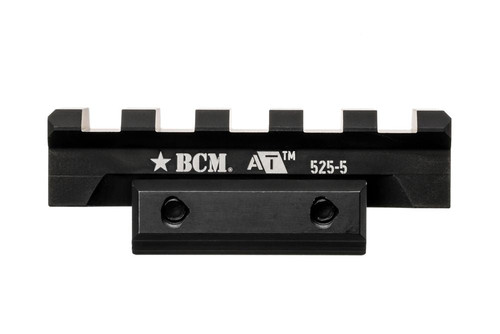
If you want to raise an existing optic and mount rather than replace them, the BCM A/T Optic Riser adds 0.525" under whatever you already run.
Key Features
- Two heights, one optic — 1.63" lower-third cowitness or 1.93", both for the Aimpoint Micro T2
- Angled Torque clamp — approximately twice the clamping force at the same torque as a horizontal interface
- Multiple integral recoil lugs — the mount engages the rail directly and holds zero
- 7075-T6 billet, minimal part count — fewer joints, fewer places for zero to shift
- Defined torque figure — 65 in-lb (7.3 Nm) maximum, so fitting is repeatable rather than guessed
Compatibility & Fitment
Fits the Aimpoint Micro T2 and mounts to any Mil-Std 1913 Picatinny rail on an AR-15/M4. Both versions accept the same optic, so choose on height alone: 1.63" gives lower-third cowitness with standard AR-15 iron sights, while 1.93" raises the sightline for a more upright head position, a helmet, or night vision. Tighten the clamp to no more than 65 in-lb (7.3 Nm) — the angled-torque interface generates roughly twice the clamping force of a horizontal one at the same setting, so over-torquing gains nothing and risks the hardware.
Technical Specifications
Platform | AR-15 / M4 |
Fits | Aimpoint Micro T2, mounted to any Mil-Std 1913 Picatinny rail |
Type | One-piece optic mount — optical centerline 1.63" (41 mm) or 1.93" (49 mm) |
Material | 7075-T6 billet aluminum; hardened steel alloy clamp with nitride-coated nut |
Finish | Hard-coat anodized, Mil-A-8625F |
Mount Interface | A/T angled-torque clamp to Mil-Std 1913 Picatinny; maximum 65 in-lb (7.3 Nm) |
Made in | USA |
Brand | Bravo Company USA |
US Shipping & Support
Shipped from D&R Sports Center in the USA with fast, tracked delivery. Questions on fit, mounting or which model suits your setup? Our team is glad to help before and after your purchase.
Frequently Asked Questions
Do the two versions fit different optics?
No. Both are made for the Aimpoint Micro T2 and take the same optic. The only difference is optical centerline height: the OM-AT-21 sits at 1.63" (41 mm) and the OM-AT-22 at 1.93" (49 mm). The decision is purely about how high you want the sightline.
Which height should I choose?
1.63" is the lower-third cowitness height, so standard AR-15 iron sights appear in the bottom third of the optic window and your cheek weld is the traditional one. 1.93" raises the optic for a more head-up posture, which is easier to hold over a long deliberate string, and gives clearance for a helmet, eye protection or night vision. If you shoot with irons as a backup and want them in view, take 1.63".
What torque should I use?
No more than 65 in-lb (7.3 Nm). The angled-torque clamp triangulates its force onto the rail and produces approximately twice the clamping force of a conventional horizontal interface at the same setting, so the correct figure is lower than instinct suggests. Use a torque wrench rather than feel.
Will it hold zero if I take it off and put it back?
The multiple integral recoil lugs index the mount into the rail slots, which is what makes return-to-zero repeatable when it goes back in the same position on the same rail. As with any Picatinny mount, note which slot you were in and confirm zero after refitting rather than assuming it.